Bible
Verse
Patience, for the Lord’s Coming Is Near.
James 5:7-11 --- Therefore be patient, brethren, until the coming of the Lord. Think of how patiently a farmer awaits the precious crop from his fields until they have received the early and the late rains. You too must be patient. Take courage, for the coming of the Lord is near.
Brethren, do not raise complaints against one another lest you yourselves be brought to judgment. Behold, the Judge is standing at the gates.
As an example of patience in enduring hardship, brethren, consider the Prophets who spoke in the name of the Lord. Indeed, those who had perseverance are the ones we call blessed. You have heard of the perseverance of Job and have come to understand the Lord’s purpose in this respect, because the Lord is merciful and compassionate. (NCB)

President's Report
Greetings fellow HAMS (Amateur Radio Operators),
It was cool to see so many of my friends at the Huntsville Hamfest this year. I must say that it was one of my better Hamfests. Following this upcoming meeting, we will have a DMR equipment and setup workshop. If you are needing help with setting up your Hotspots and Radio's, we should have enough knowledge among us to get you going. Please remember to bring your toys (i. e. Hotspots, Radios, VNA's and Antenna Analyzers) with you so we can figure them out.
Our next meeting will be held September 5th at 9am, at the Suqalena Volunteer Fire Dept. at the corner of Hwy. 19 and 494.
God Bless!
73's
Wayne Myhre,
Next MARC Business Meeting
IMPORTANT NOTE: MEETING TIME AND LOCATION
The next business meeting will be held at Suqualena Volunteer Fire Department, 10432 Highway 494 (just off of Hwy 19 - north of Meridian) from 9am until... on Saturday September 5th.
W5J
The VJ Day Special Event in Commemoration of the end of WWII
The Meridian ARC will host a special event commemorating of the end of WWII 81 years ago, to be held August 29th thru September 2nd 2026. There will be beautiful commemorative picture QSL card for those who contact us. Our call sign will be W5J. The following will be the subject of the event:
Lest we ever forget!
The official end of World War II occurred on September 2nd, 1945, when Japan formally signed the instrument of surrender aboard the Iowa class Battleship, USS Missouri in Tokyo Bay 81 years ago.
Key Dates of the End of WWII
May 8th, 1945 (V-E Day): Germany signed its unconditional surrender, marking the end of the war in Europe.
August 15th, 1945: Japan announced its surrender (broadcast by Emperor Hirohito).
September 2nd, 1945: Official signing of the surrender document, on The Battleship Missouri in Tokyo Bay, ending the war globally.
The event will be conducted by a special team of members from the Meridian ARC (Mississippi)
Congratulations!
Wayne winning an IC7300 at Gigaparts in Huntsville during HAMFEST.

WELCOME to MERIDIAN
If heard on the air, please welcome Mark Self, WM5S and his wife Tracy, AF5ZO to Meridian.

September Rolling In
"As September rolls in and the HF bands start shifting, make sure to check your antenna connections before the fall winds hit!"
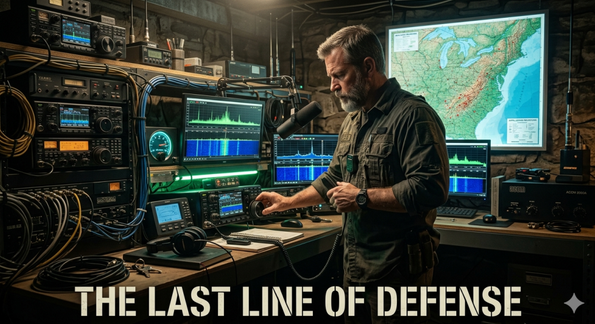
The Silent Collapse: Why Your Digital Lifeline Will Fail When You Need It Most
D. Bryan King on July 22, 2026
1,391 words, 7 minutes read time.
The modern communication grid is a fragile house of cards. We live in an era of hyper-connectivity, yet our ability to coordinate in a crisis has never been more unstable. For decades, we traded the slow, ugly, but undeniably resilient copper-wire networks of the past for the sleek, high-bandwidth digital infrastructure we use today. We were sold the promise of universal connectivity, but we were never warned about the hidden cost of that technological transition. When the grid fluctuates or a true disaster strikes, your cellular service and internet connection are the first things to vanish. You have been left dependent on a system built for commerce and entertainment, not for survival. The reality is that the systems you trust are optimized for efficiency rather than mission-critical reliability during a period of systemic stress.
The Failure of Power-Dependent Infrastructure
The failure of modern networks during a disaster is not an anomaly; it is a predictable outcome of current system architecture. Traditional landlines were line-powered, meaning they drew electricity directly from the telephone exchange, allowing them to function even when the power in your home was completely dead. Today, your digital life is tethered to a long chain of power-dependent nodes. From your home router to the fiber-optic switches and the cellular towers themselves, every single point of failure requires a constant, stable flow of electricity. When the utility grid dies, your network does not just degrade—it evaporates into the air. This reliance on fragile digital infrastructure is a massive strategic failure that leaves the average citizen blind and deaf the moment the lights go out.
The reality is that your smartphone is an entertainment device first and a tool for survival second. During any major event, the commercial network becomes a congested bottleneck where priority data packets are delayed or dropped entirely by overworked switches. We have traded a dedicated, circuit-switched infrastructure for a shared, packet-switched network that is highly susceptible to the noise of public panic. When every resident in a county attempts to access the same web portals simultaneously, the entire system enters a state of perpetual failure. This is not a temporary inconvenience for the prepared man; it is a fundamental flaw in the design of commercial communication that necessitates a complete departure from reliance on these systems.
The Tragedy of Modern Network
Saturation Even when power is partially maintained, the network remains a casualty of its own design. Modern digital systems are not built to handle the massive, synchronized surge of traffic that occurs during a localized or regional crisis. As soon as a disaster hits, the general population turns to the internet to stream updates, check social media, and place frantic calls to family members. This predictable surge causes instant saturation, resulting in high latency and packet loss that renders the network useless for critical coordination. While you are struggling to load a single status update, emergency services are fighting for the same bandwidth on a congested system that was never architected to prioritize their traffic under such extreme load.
If you are relying on a smartphone to coordinate your family or your community in a grid-down scenario, you are relying on a tool that is destined to fail you when you need it most. We have systematically dismantled the physical redundancies that once provided a baseline of safety for our homes and neighborhoods. The transition to Voice over Internet Protocol and mobile-only infrastructure has effectively removed the fail-safe layer that citizens could rely on in the twentieth century. We no longer have a hardened, analog backup that functions independently of the commercial internet. We have abandoned a centralized, utility-grade infrastructure in favor of a decentralized, fragile spiderweb of hardware that is easily severed by wind, fire, or physical damage.
The Necessity of Independent Signal Architecture
The total collapse of the communication grid is an inevitable consequence of our collective dependency on commercial systems. To maintain a heartbeat of intelligence when the grid fails, we must move toward an autonomous, hardware-based communication strategy. This shift requires a return to fundamentals, prioritizing the establishment of independent, off-grid communication hardware such as amateur radio or GMRS systems that function without commercial infrastructure. By developing redundant signal paths, you ensure that critical information can travel even when primary networks are saturated or dead. You must accept personal accountability for your own intelligence-gathering capabilities rather than waiting for corporate or government-managed systems to provide you with the connectivity you require.
Building this capability is not a task for next year; it is an urgent necessity for the man who intends to protect his own. Every upgrade to our fiber and wireless systems has only served to increase our dependency on a brittle network that demands constant power and maintenance. Returning to a state of readiness requires us to acknowledge that the old ways of engineering for survival were abandoned for the sake of profit, leaving us with a significant gap that only personal initiative can fill. A group that can communicate effectively without the internet is a group that can survive when others are left scrambling for information.
Restoring Your Autonomous Connectivity
The fragility of our modern communication network demands that we take immediate steps to reclaim our ability to coordinate in a crisis. Relying on corporate-owned, power-dependent systems is a tactical error that leaves your family vulnerable when the grid inevitably fails. By returning to the principles of independent signal architecture, we can ensure that our local communities remain informed and resilient regardless of the status of the commercial infrastructure.
Prioritize Redundancy: Build multiple, diverse signal paths to ensure that critical information survives even when primary infrastructure suffers physical or electrical damage.
Establish Independent Hardware: Utilize amateur radio or GMRS systems to create a communication layer that functions entirely outside the commercial internet and cellular grid.
Enforce Operational Discipline: Develop the skills necessary to transmit concise, mission-relevant intelligence that avoids the noise of public panic.
Take Command: Build Your Off-Grid Communication Baseline Today
The luxury of assumed connectivity is a dangerous delusion. Every minute you wait to build an independent communication capability is a minute you spend gambling with your family’s safety. When the infrastructure collapses and the screens go dark, your ability to gather intelligence and coordinate movement will be the only factor separating those who are prepared from those who are waiting for help that will not arrive. You do not need an engineering degree or a mountain of capital; you need the tactical mindset to secure a reliable, field-ready radio setup and the discipline to master it before the next crisis forces your hand. The window to establish your own signal architecture is open now, but it will slam shut the moment the first utility pole falls.
Your next move is to acquire the baseline hardware—a high-quality GMRS or amateur radio transceiver, a portable power source, and a simple antenna system—and get on the air to test your range. Do not wait for a perfect, static-free signal or a government-mandated emergency alert; start testing your reach into your local neighborhood and regional nodes today while the commercial grid is still up to provide a baseline for comparison. True readiness is not bought in a box; it is forged through iterative testing, repeated failure in controlled environments, and the refusal to be silent when the world around you loses its voice.
Link to the original article: https://bdking71.wordpress.com/2026/07/22/the-silent-collapse-why-your-digital-lifeline-will-fail-when-you-need-it-most/
Upcoming Hamfest
Daleville, Al. Hamfest September 12, 2026 - The 3 club (Daleville, Enterprise & Dothan) Hamfest will be at the Daleville Convention Center,
750 S Daleville Ave, Daleville, AL 36322
Bud's Fall Tailgator (fall) September 26, 2026 - Steele Creek Park,
368 Juniper Ave. Satsuma, Alabama 36572
 September 2026