THE SPARK GAP
A monthly publication of the Meridian
Amateur Radio Club May 2026 May 2026


Bible
Verse
Psalm 139:13-24 --- You created my inmost being; you knit me together in my mother’s womb. I praise you because I am wonderfully made; awesome are your works, as I know very well. My body was not hidden from you when I was being made in secret. When I was woven together in the depths of the earth, you saw me in the womb. The sum total of my days were all recorded in your book. My life was fashioned before it had come into being.
How precious to me are your designs, O God! How vast in number they are! (NCB)
President's Report
Greetings fellow HAMS,
Another month of Amateur radio news. Many things are covered on this month's Spark Gap. One thing of excitement will be the upcoming function, Collinsville Day. Meridian club will have an exhibition booth. We would like to invite area hams and those of interest to stop by and visit. Larry Anderson K5LDA has prepared a nice web page for the upcoming event, which will be on May 2nd. https://www.qrz.com/db/W5C
Again, please come by and enjoy your visit and view all the booths and live music. The volunteer fire department will be preparing a fund-raising food plate for a reasonable fee. Since this is the first Saturday, our club members will have our regular meeting at the event. Hope to see y'all there.
73's
Wayne Myhre, KC5HPU
Next MARC Business Meeting
IMPORTANT NOTE: MEETING TIME AND LOCATION
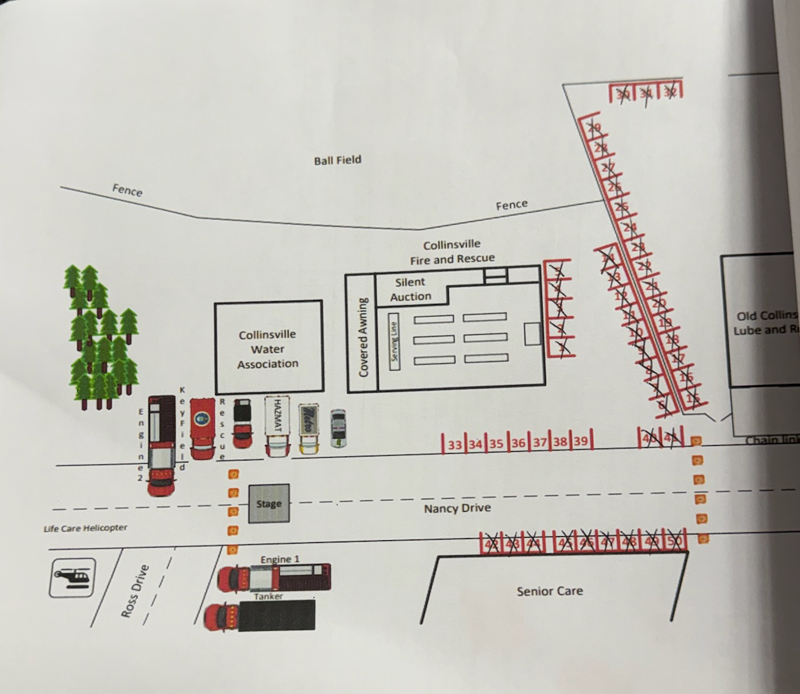
The next business meeting will be held at the Collinsville Day setup site (Collinsville Fire and Rescue) on Saturday May 2nd around 9 A.M. See map below. Come join us. Address: 11710 Nancy Dr, Collinsville, MS 39325
Collinsville Day
MARC will be setup and operate at Collinsville Fire and Rescue during the Collinsville Day event on May 2nd. Come out and join us, it's a good opportunity to see how we setup a field station and get on the air in times of need. We will meet Friday evening around 7pm to put up a tower with antennas. Saturday around 7am we will set up table, tent, and radios. As soon as that is done we can start operating.
Map below... See you there!
Meridian ARRL Volunteer Exams
Below are our newest test dates.
- May 23, 2026
Testing begins at 10:00AM.
Location: Lauderdale County EOC (LEMA)
2525 14th Street
Meridian, MS 39301
Pre-Registration preferred. Please call or email Eldon Richardson if you are interested in testing: Email or call
(601) 227-6690
Memorial Day
 |
Monday, May 25th is Memorial Day honoring and mourning the military personnel who have died in the performance of their military duties while serving in the United States. Please keep all of our military service members in your daily prayers. Please pray for PEACE throughout this fragile world. |
Start Your Field Day Planning
The 2026 ARRL Field Day is June 27 - 28 and is always one of the biggest operating events of the year. Many clubs across the country say that Field Day is their most popular event for a variety reasons. Some clubs treat it as a contest (even though no one wins Field Day). It is a great chance to see what contesting is like with much less pressure. Some clubs make it a training event for emergency operations by setting up in a different location and trying to communicate with antennas using power that is temporary. Other clubs hold a family gathering for members and guests to get together and have fun around the radios.
It is also a fantastic opportunity to show off the capabilities of ham radio to the public. Invite the mayor, the fire chief, the police chief, or other local agencies to come by. Get them on the air to make a contact or two. |
|
ARRL resources are available online at field-day.arrl.org. Do not forget to check out the ARRL Store for Field Day swag to help make the weekend fun. Get a t-shirt, a hat, or other merchandise to commemorate the event. Also, make sure to put your club's Field Day site on the Field Day Station Locator at Field Day Station Locator (arrl.org).
Voyager 1
I recently came across a post about Voyager 1 so decided to dive deeper into the project. AI came up with some interesting DATA I thought you might enjoy.
Voyager 1 is one of the most remarkable spacecraft ever launched—basically humanity’s farthest-traveling ambassador to the cosmos.
Quick overview
- Launched: September 5, 1977 by NASA
- Original mission: Study the outer planets—mainly Jupiter and Saturn
- Current status: Still operating, sending data from interstellar space
What makes it special
Voyager 1 completed its planetary mission in the early 1980s, but it didn’t stop there. It kept flying outward and, in 2012, became the first human-made object to enter interstellar space—the region beyond the Sun’s influence.
- It’s now over 15 billion miles (24+ billion km) from Earth
- Signals take over 20 hours to reach us
- It’s still communicating using a radio dish called the Deep Space Network
The Golden Record
Attached to Voyager 1 is the famous Voyager Golden Record, a gold-plated disc designed to tell any potential extraterrestrials about life on Earth. It includes:
- Music from around the world (from Bach to Chuck Berry)
- Greetings in 55 languages
- Sounds of Earth (wind, thunder, animals)
- Images of humans, nature, and technology
What it’s doing now
Even decades later, Voyager 1 is still sending back valuable data about:
- Cosmic radiation
- Magnetic fields in interstellar space
- The boundary of the Sun’s influence (the heliosphere)
However, its power is fading. It runs on a radioisotope generator, and scientists expect its instruments to gradually shut down—likely sometime in the 2030s.
Fun perspective
If Earth were a city block, Voyager 1 would be thousands of miles away—and still moving.
If you want, I can explain how it communicates from that distance or what problems it’s having now (it’s had some weird glitches recently).
Explain how Voyager 1 communicates from that distance
Voyager 1 is so far away that communicating with it is less like a phone call and more like whispering across the continent and still being heard. Here’s how it actually works.
�� The basic idea
Voyager 1 sends radio signals back to Earth using a transmitter and a large dish antenna. Those signals travel at the speed of light until they’re picked up by giant receivers on Earth.
The system on our end is called the
Deep Space Network (DSN).
�� The Deep Space Network
The DSN is a set of enormous radio antennas placed around the world so at least one is always pointed at Voyager:
- Goldstone Deep Space Communications Complex
- Madrid Deep Space Communications Complex
- Canberra Deep Space Communication Complex
Each site has dishes up to 70 meters (230 feet) wide—huge enough to detect Voyager’s extremely faint signal.
�� Why it’s so difficult
Voyager 1’s transmitter is only about 23 watts—weaker than a typical light bulb.
By the time its signal reaches Earth:
- It has spread out over billions of miles
- It’s incredibly faint (far weaker than background noise)
- Data arrives very slowly (as low as ~160 bits per second, slower than early dial-up)
NASA uses advanced signal processing and error correction to reconstruct the data.
⏱️ The time delay
Because Voyager 1 is so far away:
- A command from Earth takes ~20–22 hours to reach it
- A reply takes another 20–22 hours
So a simple “question and answer” takes nearly 2 days.
�� How communication actually happens
- Engineers send a radio command via the DSN
- Voyager receives it with its antenna
- It executes the command (like turning on an instrument)
- It sends data back as a radio signal
- DSN antennas capture and decode it
�� The limiting factor
Voyager 1 runs on a nuclear power source that slowly weakens over time. As power drops:
- Instruments are turned off one by one
- The transmitter weakens
- Eventually, communication will stop (likely in the 2030s)
�� A good way to picture it
Catching Voyager’s signal is like detecting the energy of a single snowflake hitting the ground—from thousands of miles away.
Quote of the Month
"May, queen of blossoms, and fulfilling flowers, what pretty music shall we charm the hours?" - Edward Thurlow
Have a BLESSED month!
Last Month  Next
Month Next
Month
Back to The Spark Gap
|