
Amateur radio serious business
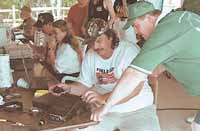
HARD AT IT - Russell Brown talks on one of the
radios during the Meridian Amateur Radio Club's
annual field day Saturday, while Donna Harrison
talks on another. Looking over Brown’s
shoulder is Phillip Duke. The club spent the night
at Bonita Lakes, making contacts with other ham ope
rators across the nation. |
|
By Steve Swogetinsky/The Meridian
Star
June 24, 2001
Sometimes, serious business can be a lot of fun.
That’s how amateur radio operator Mel Oubre summed up
the all-nighter he and fellow members of the Meridian
Amateur Radio Club pulled Saturday during their 24-hour
emergency drill field day.
“This is a nationwide drill,” Oubre said as
members worked to convert the second pavilion at Bonita
Lakes Park into an open air “hamshack.”
“We set up antennas and operate on emergency power
generators and batteries for 24 hours. If there were some
sort of disaster that knocked out the power and
communications, emergency management would rely on the
amateur radio operators to send messages. We want to be
ready in case that ever happens,” Oubre said.
Retired from the Navy and Delco Remy, Oubre has been a ham
radio operator since 1984. He said he might spend as little
as 20 hours with his radios on some weeks, and as many as
100 hours at other times.
“It depends on what is going on,” Oubre said.
“I’m one of the storm watchers for the National
Weather Service. If we are having bad weather, I could be on
the air communicating with the weather service office in
Jackson.”
Oubre was classified as a novice when he became an amateur
radio operator in 1984, and has moved up to over the years
to “extra class.” He said how much a person spends
in becoming an amateur radio operator depends on the
individual.
“You can get into it for $200 to $300, or you could
spend several thousand dollars,” Oubre said. “A
good HF base station will cost between $1,000 to $1,800.
Some might cost more, some less, depending on what you want
to do.”
The object of the weekend drill is to contact as many
different amateur radio stations and operators as possible.
This information will be sent to the American Radio Relay
League, which will compile reports from operators from
across the nation and publish a report.
Last year, the Meridian club made more than 800 contacts,
and Oubre predicted with two stations working, it would be
more than 1,000 this year. While some contacts might be
international, most were made within the United States.
Not all of the talking is being done by voice. John Ziller
was operating a digital radio setup with a computer
gathering information from his radio.
“I just click and send a message,” said Ziller,
who has been an amateur radio operator for about 13
years
“This is a good hobby for someone who is retired. But
it is important work. In a real emergency when the power is
out, people count on the ham operators for communications
because they have the backup power.”
During a time of bad weather, anyone with a scanner can
listen to the Meridian amateur radio operators by tuning in
146.700.
The drill wasn’t all work. While one group talked on
their radios and another was setting up a third antenna,
others were grilling hamburgers. They’ll be at Bonita
Lakes Park until 1 p.m. today.
The club holds its official meeting every first Saturday at
the Magnolia Inn, starting at 9 a.m., said Mike Harbour, a
longtime member. They also get together on the other
Saturdays at the same time for unofficial meetings.
“It’s great fellowship, and you enjoy being around
people who are interested in what you are interested in.
We’ll go home tired after the field day, but this is
something we enjoyed doing,” Harbour said.
Steve Swogetinsky is regional editor of The Meridian Star.
Call him at 693-1551, ext. 3217, or e-mail him at
sswogetinsky@themeridianstar.com.